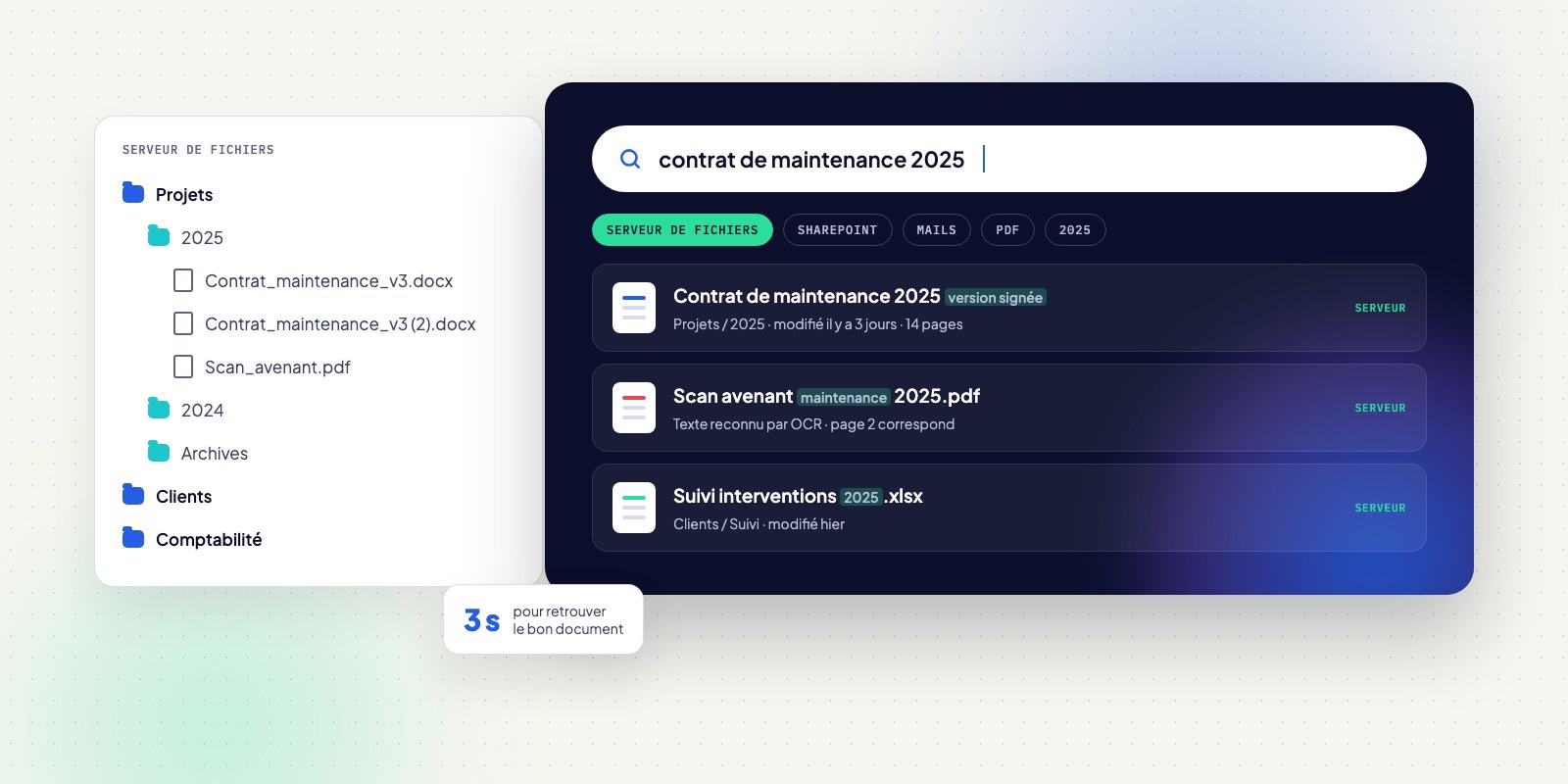
Finding a document on the company's file server should take just a few seconds. In practice, however, the opposite is often true: dozens of nested folders, vague file names, duplicate versions, and a search that turns up nothing. This article explains why a file server’s native search quickly reaches its limits, offers four practical best practices, and demonstrates the benefits of an enterprise search engine like Outmind.
Whether you're working on a Windows server, a NAS, or a Linux network share, the built-in search tool almost always has the same limitations:
File search software fills some of these gaps, including network drives and NAS devices: we compare them in our article on alternatives to Windows Search. It also explains why a server shared by the entire team is better suited to a shared index that enforces each user’s access rights.
To learn more about these limitations and see how to work around them without moving the documents, visit our page dedicated to AI search in file servers.
The real cost isn't the minute lost; it's the decision made based on the wrong version, or the document that has to be recreated because it couldn't be found.
Before switching tools, following a few simple rules can already make a significant difference.
These practices have a limitation: they rely on individual discipline and do not address scanned documents or files scattered across the server, email, and collaboration tools.
The Outmind connector for file servers is powered by an enterprise search engine that indexes the content of your documents—wherever they are stored—and makes it searchable from a single search bar. Outmind connects to your file server, as well as to SharePoint, Teams, Google Drive, iManage, and your email inboxes, without moving a single file. In practice, you get:
Generative AI complements research: you ask a question in natural language and receive an answer that cites source documents, including those from the file server.
In Outmind, filters let you display only PDFs, presentations, spreadsheets, or folders, and combine that filter with a time period or a source. The number of results drops significantly in just a few clicks.

The search covers the content of all indexed files, including scans. To save time, the "Pages" tab lists every page where the word appears: you can open the correct section of the correct document right away, without having to scroll through fifty pages.
A well-organized file server remains essential, but its built-in search function does not scan content, scans, or files stored anywhere other than on the server. Best practices for naming and archiving help minimize problems. To find any document in seconds—whether on the server or in the rest of your tools—an enterprise search engine makes all the difference.
Want to try it out on your own files? Request an Outmind demo, or explore the file server connector.