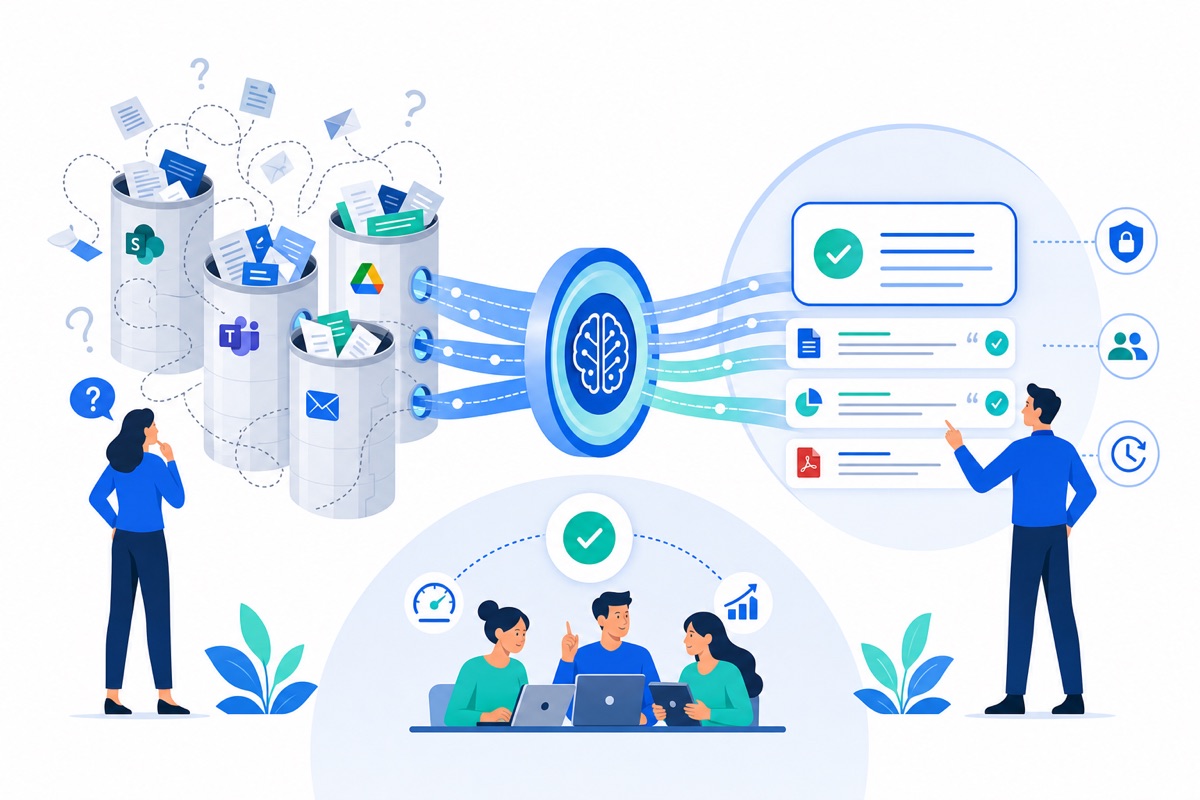
In most organizations, information “exists.” The real operational bottleneck is more subtle: when it comes time to take action, the team can’t find the right evidence—in the right version—with the right context. As a result, decision-making slows down, deliverables are sent back for rework, and trust in internal sources erodes.
A data silo arises when information that is essential to a process is technically available but practically unusable at the moment a team needs to make a decision.
This distinction (available vs. usable) is key, because it shifts the focus: we don’t “organize things better” to solve a problem of reliable access; instead, we establish a search capability that links sources, context, rights, and traceability.
IBM defines enterprise search as the ability to retrieve relevant information from disparate sources (document management systems, CRM, knowledge bases, collaboration tools, line-of-business applications), and notes that modern platforms add semantic search and response generation capabilities (IBM, March 6, 2026, Enterprise search https://www.ibm.com/think/topics/enterprise-search)
What this means for a project team: If your “project files” are scattered across SharePoint, Teams, email, and a project management tool, performance depends less on where the document is stored than on your ability to find, review, and reuse it in a matter of seconds.
The most common pitfall is confusing “everything is on SharePoint/Drive” with “we have reliable access.” The research brief provides a simple grid that clears up this confusion:
Outmind explicitly states this point: the presence of documents in SharePoint, Teams, Drive, Confluence, or email does not guarantee that they are complete or up-to-date at the time a decision is made (Outmind, May 11, 2026, Internal Corporate Search https://www.outmind.ai/blog/recherche-interne-entreprise)
What this means for an Operations Director: the most costly risk isn’t just “finding nothing”; it’s finding—quickly—a plausible but incomplete version of the truth, and making a decision based on incomplete information.
When teams say, “Search works pretty well,” they’re often referring to the ability to find something. But several structural issues make traditional search unreliable in the real world: differences in vocabulary between queries and documents, context spread across different tools, the importance of non-textual data, and internal jargon that evolves over time.
Atlassian specifically outlines four reasons why traditional search fails: vocabulary mismatches, context scattered across tools, the prevalence of structured non-textual data, and the constant evolution of internal jargon (Atlassian, March 16, 2026, “Advancing Rovo Semantic Search” https://www.atlassian.com/blog/atlassian-engineering/advancing-rovo-semantic-search)
What this means for a Knowledge Manager: without a search engine capable of handling synonyms, business entities, and relationships between objects (tickets, pages, conversations), you end up dealing with symptoms (duplicates, outdated documents, “do you know where that is?”) rather than optimizing knowledge access performance.
Useful internal AI search within a team is not limited to a conversational interface. It must produce actionable output: an answer, the excerpts that support it, the sources, and a path to verification.
The brief summarizes this evolution as a shift from a “document or link” model to a “response + context + evidence + next action” model (Enterprise Knowledge, March 17, 2026, “Moving Beyond Q&A to Context, Discovery, and Action” https://enterprise-knowledge.com/whats-next-for-search-moving-beyond-qa-to-context-discovery-and-action/ )
Internal search AI creates value when it reduces the time between a question and a verifiable decision, not when it merely increases the volume of results.
An experimental study published on March 22, 2026, found that, in an insurance CRM scenario, manual searches took an average of 39.7 seconds per query, compared to 2.8 seconds using the system under study—a 14-fold difference; the study estimates a time savings of 1.4 to 1.9 hours per day in the observed scenario (arXiv, March 22, 2026, SalesCopilot https://arxiv.org/abs/2603.21416)
What this means for a sales or project team: as soon as your processes involve repeated micro-searches (status, KPIs, latest version, approved decision), performance depends on cumulative latency, and an improvement “per query” translates into a noticeable gain over the course of the day.
A study published on April 17, 2026, concludes that an architecture combining a lexical index, vector search, RAG, and application controls improves task retrieval and execution compared to conventional search, while reducing hallucinated responses by approximately 40% in its evaluation (ResearchGate, April 17, 2026, Enhancing Enterprise Application Search Using Retrieval-Augmented Generation https://www.researchgate.net/publication/404077127_Enhancing_Enterprise_Application_Search_Using_Retrieval-Augmented_Generation_A_Hybrid_Indexing_and_Reasoning_Approach )
What this means for an IT department or Chief Information Security Officer (CISO): Reliability cannot be achieved simply by having “a good model.” It depends on a comprehensive chain of processes (retrieval, access controls, citations, latency, phased deployment) that minimizes the risk of convincing but false responses.
The ROI of an AI-powered internal search is difficult to justify when it is reduced to the number of queries. It becomes tangible when linked to a collaborative process: preparing for a steering committee meeting, incident analysis, onboarding, contract review, or responding to a request for proposals.
The brief proposes a simple order-of-magnitude model (to be customized): three 11-minute searches per day over 220 business days amount to approximately 121 hours, or 15.1 8-hour days per year; the “11-minute” baseline is presented as a real-world example used by Outmind in the context of searching for a known map, and its generalizability must be validated through a customer survey (Outmind, LinkedIn post cited in the brief, July 28, 2026: https://www.linkedin.com/company/outmind-app )
What this means for operations management: Even a conservative model shows that “minor frictions” add up to lost operational capacity on a large scale—and that the question isn’t “how many documents,” but “how many delayed decisions.”
Microsoft is evolving SharePoint toward an “AI-first” experience and has announced “AI Skills” mechanisms to formalize reusable processes (Microsoft Tech Community, April 21, 2026 https://techcommunity.microsoft.com/blog/spblog/introducing-new-agentic-building-in-sharepoint-and-more-updates/4497987/replies/4500033 )
But the key point for your governance is this: an assistant relies on existing permissions. Microsoft states that “Restricted SharePoint Search” is not intended as a long-term or scalable solution and recommends addressing oversharing through SharePoint Advanced Management and Microsoft Purview (Microsoft Learn, July 2026, Restricted SharePoint Search https://learn.microsoft.com/en-us/sharepoint/restricted-sharepoint-search )
Conversational AI amplifies the quality—or the flaws—of your document foundation (rights, versions, recency, architecture).
What this means for an internal sponsor: the question isn’t “Copilot or no Copilot,” but “do we have a governed foundation and cross-functional search that also covers what isn’t in M365?”
If you need to design an evaluation (pilot or internal benchmark), here is a practical checklist aligned with the evidence and risk points mentioned in the brief.
What this means for a Project Manager: the right tool is the one that lets you verify “with a single click” where the information comes from, rather than the one that responds the fastest without providing evidence.
Internal AI-powered search becomes a team capability when it is deployed where silos are most costly: recurring decisions, reporting, transitions (onboarding), or risks (audits/contracts).
The brief recommends basing the value on operational events (steering committee meetings, requests for proposals, incidents, onboarding, audits) rather than on individual “chatbot” usage (Outmind Research Brief, July 28, 2026).
The most robust deployment is one that transforms a collaborative workflow (and its metrics), not one that adds a layer of AI without defining the expected evidence and access rules.
Document silos represent a debt of time, trust, and risk (Outmind Research Brief, July 28, 2026). Internal AI search is effective when it addresses these three components at their source: unifying access, reducing ambiguity (versions, context), and making every answer verifiable.
If you had to remember just one rule for structuring your project: don’t judge internal AI research by the beauty of its interface, but by its ability to produce faster, auditable decisions based on sources that are truly comprehensive and properly governed.