Reading time: less than 7 minutes
Let's be honest: in 2026, everyone is talking about AI in business. The budgets are there, as are the tools. And yet, the reality on the ground is far less glorious than LinkedIn posts would have us believe.
Many of the generative AI projects deployed in companies fail to deliver on their promises. The models hallucinate, the responses are irrelevant, and teams lose confidence in the tool after two weeks. And the culprit is almost never the model itself—it's what we feed it.
When you install ChatGPT or an AI assistant in a company, you expect it to "know" the company. You expect it to find the right version of the framework agreement, to be able to summarize the minutes of last Tuesday's project meeting, and to identify the quality procedures in place.
Except that generative AI, by default, knows nothing about your business. It is trained on public data. If you don't give it access to your internal documents—and especially if those documents are not properly indexed and organized—it simply cannot help you.
This is what specialists call the RAG (Retrieval-Augmented Generation) problem: the quality of the AI's response depends entirely on the quality of the search that precedes it. In other words, if your internal search engine is poor, your AI assistant will be too.
And that's where many organizations run into trouble.
A company with 200 employees easily has hundreds of thousands of documents spread across SharePoint, Google Drive, local servers, Outlook, Teams, Dropbox, a CRM, a project management tool, and more. Not to mention archives, PST files, and attachments forgotten in emails from 2019.
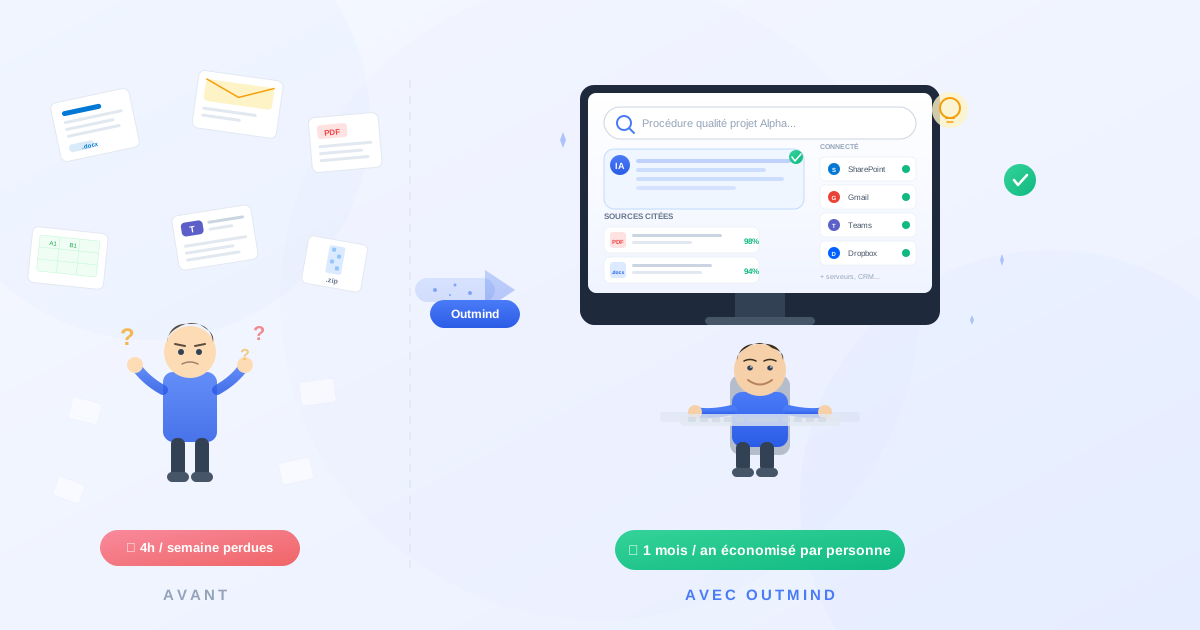
The result: employees spend an average of four hours per week searching for information. This isn't just a random figure—it's a constant that appears in study after study, from McKinsey to Gartner.
Four hours a week. Twenty hours a month. Almost a whole month a year spent searching through files, rewriting research, sending emails asking "do you know where the file for... is?", and then ending up recreating a document that already existed somewhere.
This problem is not new. But it has been exacerbated by the explosion in the number of SaaS tools (88 on average per company, according to Okta) and by remote working, which has further fragmented information sharing.
In 2025-2026, one lesson clearly emerges from companies' feedback: without structured knowledge management, generative AI does not work.
The organizations that have made the most of AI are not those that chose the most powerful model. They are those that already had, or implemented, a real strategy for accessing information: well-indexed documents, unified search, respect for access rights, and a way for every employee to find what they need without being an expert in file trees.
This is precisely why solutions such as Outmind exist. Rather than adding yet another tool to an already crowded landscape, Outmind connects to all existing tools (Office 365, SharePoint, Google Drive, Dropbox, servers, emails, CRM, etc.) and allows you to search everything from a single location. All while respecting existing access rights—a critical point often overlooked by competing solutions.
When we talk about "enterprise search," many people think of the SharePoint search bar. Spoiler alert: that's not enough. The native search engines of collaborative tools are designed to search within a tool, not across all tools.
A search engine worthy of the name must be able to:
Outmind has built its solution on these four pillars. And it is this foundation that makes a truly useful AI assistant possible: an assistant that provides reliable, sourced answers based on real company documents—not hallucinations.
RAG (Retrieval-Augmented Generation) technology is now the standard for connecting an LLM to a company's data. The principle is simple: before generating a response, the AI searches your document database, retrieves the most relevant passages, and uses them to formulate its response—citing its sources.
But RAG is only as good as the retrieval that feeds it. If your retrieval layer doesn't find the right document, the model won't be able to give the right answer. It's as simple as that.
That's why companies that successfully deploy AI in 2026 won't just plug an LLM into a SharePoint folder. They will invest in a true knowledge management infrastructure: comprehensive indexing, multi-format search, granular permission management, and semantic understanding of the business.
Outmind's AI assistant follows this logic. It doesn't just "guess": it questions your projects, understands your business jargon, and provides traceable answers. Each answer is based on documents that you can verify. That's the difference between a gadget and a professional tool.
A worrying phenomenon is developing in companies: shadow AI. In the absence of suitable official tools, employees are using consumer versions of ChatGPT, Gemini, or Claude, copying and pasting internal data into unsecured interfaces.
The risks are obvious: confidential data leaks, GDPR non-compliance, loss of traceability. Nearly two in five companies have already implemented official AI platforms to counter this trend—but many remain exposed.
The best way to avoid shadow AI is to offer an alternative that is both powerful and secure. This is Outmind's positioning: an ISO 27001-certified solution with data encryption at rest and in transit, dedicated instances per customer, and data processing via Azure OpenAI hosted in Europe. Data is not stored by Outmind and is not used to train models.
If you are in a company that is beginning to take an interest in AI but has not yet structured its access to information, here is a pragmatic approach:
Start with search, not AI. Before deploying a conversational assistant, make sure your employees can find the right documents. If search doesn't work for humans, it won't work for AI either.
Conduct an audit of your data sources. Where are your critical documents? How many different tools are they stored in? How many are duplicates? How many are inaccessible when they shouldn't be?
Choose a tool that integrates, not one that replaces. The classic mistake is to want to migrate everything to a new tool. No one will do that. Opt for a solution that connects to your existing tools—that's Outmind's "plug & play" approach, which requires no data migration.
Measure the gains. The time saved on searching for information is directly measurable. Outmind customers report an average gain of one month's work per year per employee. That's an ROI that speaks to senior management.
Generative AI in business is not a technological issue. It is an issue of access to information. The companies that will succeed in their AI transformation in 2026 are those that understand that the model is not everything—and that an AI assistant is only as good as the knowledge base it relies on.
Knowledge management is no longer a somewhat abstract HR discipline. It is the technical foundation on which all enterprise AI rests. And organizations that ignore it will once again find themselves investing significant budgets for disappointing results.
The good news is that you don't have to start from scratch. With the right tools—ones that integrate with existing systems, respect data security, and enable rapid deployment—the path from "searching everywhere without finding anything" to "AI providing the right answers from the right sources" is shorter than you might think.
Outmind is a French knowledge management and intelligent search solution that connects generative AI to your business data. To learn more or request a demo, make an appointment here.