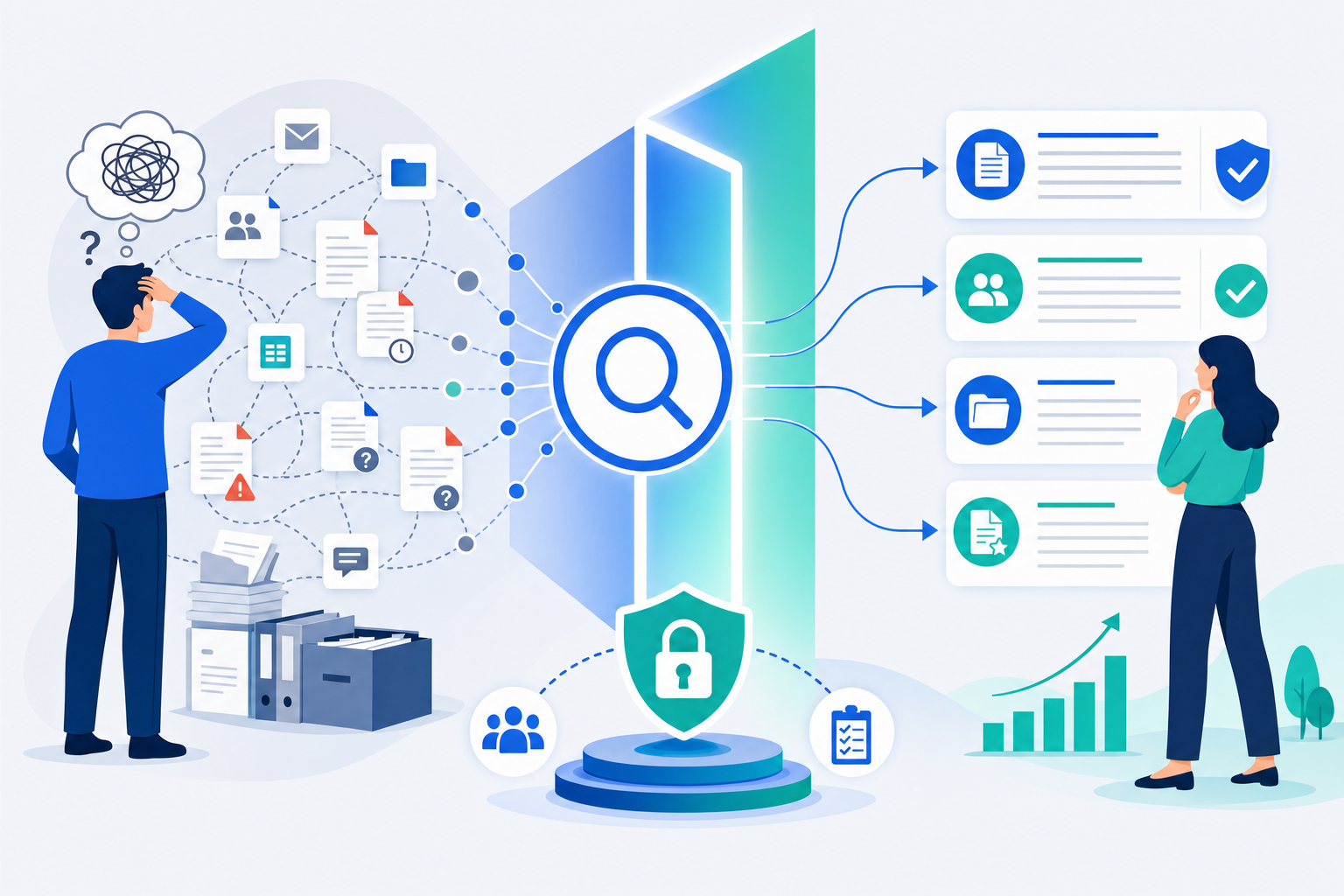
Unified enterprise search reduces wasted time, errors, and AI risks. Discover the principles and steps for making knowledge reliable and traceable.
In many organizations, knowledge isn’t “lost”—it’s fragmented, difficult to connect to a context, and therefore difficult to use safely. The true cost isn’t just the time spent searching, but also delayed decisions, rework, and the inability to prove that an answer is based on a current and authoritative source.
Unified enterprise search (a layer providing cross-platform access to servers, SharePoint, email, archives, document management systems, and collaborative workspaces) is a game-changer—but only on one condition: that search be treated as a system requiring reliability (sources, versions, permissions, traceability) and not simply as a “search bar.”
In the Outmind research brief (October 2026), Outmind is described as a unified and secure access layer to corporate knowledge, designed to enable humans and AI to retrieve information “in context,” with access rights preserved and sources verifiable (Outmind Expert Research Brief, October 2026).
One principle should guide the diagnostic process: the more tools you use, the more points of friction you create between a business question and a usable answer.
A study published on July 7, 2026, analyzed 103 million application events from 1,017 employees across eight organizations and concluded that knowledge workers switch between applications thousands of times a day, spending nearly one-tenth of their work year transitioning between applications (arXiv, 2026, Digital Fragmentation and Generative AI Use Across 103 Million Application Events).
What this means for an operations manager or a knowledge manager: if the response is distributed (an email, a project folder, a SharePoint page, a ticket, or a meeting minutes), the cost is not linear. Each transition increases the risk of:
In August 2026, IBM reported that 65% of the employees surveyed already consider the guidelines governing their work to be outdated (IBM, 2026, “The Hidden Costs of Knowledge Fragmentation”).
In practical terms, unified search should help answer a simple but critical question: “Is this the correct, approved version that applies to my scope?”
An analysis published on April 24, 2026, illustrates a common limitation: users search using everyday language, while internal policies use different terminology; the document exists, but it is not found (LinkedIn, 2026, “From Keyword Search to Intelligent Retrieval”).
For the company, this means that an investment in documentation (EDM, wiki, SharePoint) may remain underutilized if access does not align with the way teams articulate their needs.
The issue isn't "adding AI." The issue is: giving AI controlled access to knowledge; otherwise, AI only adds to the confusion.
An Alteryx study released on August 17, 2026, indicates that 77% of IT managers consider business context essential for accurate and relevant AI responses, but 53% report having difficulty integrating this context into their AI systems and workflows (IT Pro, 2026).
What this means: A unified search system isn’t just for employees. It also serves as a central hub for feeding AI assistants with consistent and traceable sources.
KPMG reported on June 11, 2026, that nearly three out of four executives cite risk, security, and privacy as among their top concerns, while only 24% of organizations proactively incorporate these factors into their strategy and technology lifecycle (KPMG, 2026).
For operations management, this translates into a practical rule: you do not “deploy” knowledge-based AI without verification mechanisms (sources, rights, auditability); otherwise, the risk is structural.
Unified enterprise search is useful when it simultaneously reduces three sources of friction: location, reliability, and evidence.
A unified access layer creates a single point of entry to repositories that remain in place, provided that access rights are replicated and each response is linked to its sources. (Outmind Expert Research Brief, October 2026)
Here are the operational principles to aim for:
Two risks coexist in multi-source environments:
A benchmark published on August 12, 2026, shows that under non-ideal conditions (document noise, conflicts between sources), the models satisfy approximately 80% of the constraints individually, but only 26.8% of the responses meet all requirements simultaneously (arXiv, 2026).
What this means for an organization: A response may seem correct in substance, but it remains unusable in production if it is not complete, traceable, up-to-date, and compliant with internal rules.
A case study published on May 27, 2026, describes a financial services company where drafts and approved policies were indexed at the same level, with archived procedures mixed in with current versions and insufficient traceability; the remediation included classifying sources, enriching metadata, mapping permissions, and creating audit trails (DataXWorks, 2026).
For the professions, the lesson is clear: without corpus governance, research (and even more so AI) industrializes ambiguity.
For a Knowledge Manager, unified search is a tool for observable governance: it reveals outdated content, gaps in documentation, and recurring questions, while reducing reliance on experts.
The October 2026 Outmind brief summarizes typical expectations and drivers in the area of knowledge management:
In practical terms: success depends less on a “big moment” in documentation than on a framework of authority (which sources are authoritative, what version statuses apply, what lifecycle rules govern) that is made visible in the research experience.
For operations management, unified search is a key driver of performance because it reduces the time between an operational question and a verifiable answer, without compromising security.
The Outmind brief (October 2026) highlights expectations on the operations side:
Key point: KPMG highlights the gap between concern and action (security/risk cited by ~3 out of 4 executives, but only 24% are proactive) (KPMG, 2026). For operations, unified search also presents an opportunity to standardize trust: the same rules, the same evidence, the same reflexes.
The Outmind research brief offers a useful industry comparison to help frame the evaluation (Outmind Expert Research Brief, October 2026):
This table does not say, “Replace SharePoint/EDM”; it says: Make their content usable across the board, with a focus on evidence.
To avoid theoretical debates, start with an area where value and risk are clear: procedures, models, project decisions, post-mortems, incidents, and quality standards.
Inspired by the risks identified in the DataXWorks case (DataXWorks, 2026) and the recommendations in the Outmind brief (Outmind Expert Research Brief, October 2026):
The brief recommends using specific operational metrics to guide the process, such as:
The goal is not to get “more research,” but to reduce uncertainty and minimize back-and-forth.
Unified enterprise search has become a matter of performance and governance, not just a matter of tools. Recent data confirm three realities: fragmentation is costly in terms of transitions (arXiv, 2026), guidelines quickly become obsolete (IBM, 2026), and trust in AI requires a structured approach to risk (KPMG, 2026).
If you want to evaluate an Outmind-style approach, the right first step isn’t a “generic demo”—it’s a pilot based on a real-world business case, with explicit rules for sources, versions, and permissions, as well as criteria for verification.