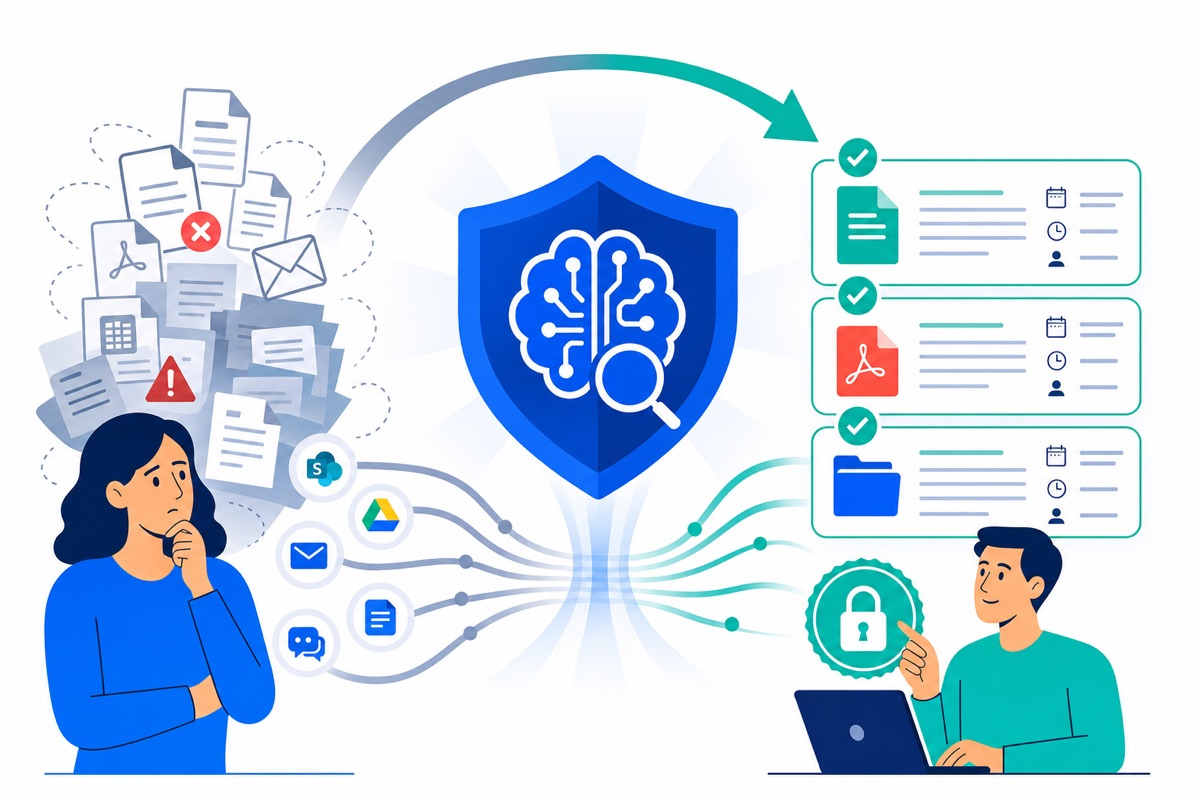
In a project team, the true cost doesn’t come solely from the time spent “locating a file.” It arises when information that is easy to find but inaccurate (outdated, incomplete, outside the scope, or unverifiable) becomes the basis for a decision, a report, a purchase, a production run, or a trade-off.
Effective internal research must first reduce information risk (wrong version, wrong source, wrong access rights); otherwise, it merely accelerates errors.
That is exactly what the people we meet describe:
These sentences aren't about “AI.” They're about operational trust.
In many organizations, storage (SharePoint, Drive, document management systems, intranets) provides a sense of control. However, searching for information remains costly and unreliable.
What this means for a PMO or project management team: stated confidence is not a performance metric, and the research effort often masks risks related to versioning, silos, and information that cannot be found “in time.”
iManage cites the coexistence of multiple tools, information silos, and email as some of the obstacles (iManage, Knowledge Work Benchmark Report 2026). In practical terms, this explains why “organizing better” isn’t enough: the reality of a project involves multiple tools and formats.
Projects are becoming more complex, and this complexity increases sensitivity to missing or contradictory information.
Insights for project managers and PMOs: As complexity increases, you need reliable access to decisions, assumptions, risks, versions, and evidence—otherwise, governance will have to be urgently reestablished (through committees, audits, or complaints) at the worst possible moment.
A case published in July 2026 describes the analysis of 12,000 P&ID drawings: 31 critical obsolete drawings reportedly would have been missed during a manual review; one example cites a parts list based on revision C, whereas the current version was F, posing a risk of failure during inspection if manufacturing proceeded based on the incorrect version (Pathnovo, 2026, commercial case study).
What this means for a project team: The danger isn’t a lack of information, but the simultaneous presence of plausible versions. Research that doesn’t prioritize the revision, date, and source can lead to making the wrong choice more quickly.
A survey of 789 Nordic PMO professionals shows that 83% work in hybrid environments (dedicated tools + spreadsheets + manual processes); and manual reporting can take up to half a workweek per month (Hypergene, The Nordic PMO Reality Report 2026, published on April 23, 2026). The study also indicates that only 17% have a dedicated project and portfolio management solution (Hypergene, 2026).
What this means for a PMO: Delayed consolidation not only undermines productivity; it also compromises the timeliness andcompleteness of the project vision—and thus the quality of decision-making.
Two signals converge:
What this means for a legal department: if the answer cannot be verified (sources, citations, scope), the “gain” turns into time spent verifying and a risk of non-compliance.
Even with a standard tool, search quality depends on ranking and indexing. An issue resolved on March 31, 2026, notably affected the prioritization of relevant results in SharePoint Online Search (NHS Support, 2026).
Implication: In a project context, a search that is “more or less” relevant may be enough to lead to a wrong decision, a rejected report, or an incorrect reference version.
The Gemini Enterprise documentation, updated on August 11, 2026, states that Google Drive extracts only 1 MB of text and formatting per file for search purposes, with size limits depending on the file type (Google Cloud Docs, 2026).
Implication: If the critical information is located beyond the indexed portion, you may have the right file… but be unable to find the right passage.
Two points to watch for have emerged from recent sources:
Implications for DSI/KM: An assistant that is “connected to data” is not automatically “governable.” Reliability requires an explicit design of permissions, scope, and evidence.
A useful internal AI search tool in a project environment should make it easier to find the right information than the wrong information, and ensure that every response can be verified.
Here is a practical, project-oriented checklist:
Outmind positions itself as a secure, high-precision AI research assistant that centralizes access to internal knowledge (product briefs and positioning architecture). The goal is not to turn work into a “chatbot,” but to add a layer of reliability on top of existing sources: dispersed sources, cross-functional research, and document-based reporting.
Two important factors for the company to evaluate:
What this means for a sponsor (Ops, PMO, KM): ROI must be tested using real-world scenarios (real questions, real documents, real constraints), because the time saved is only valuable if the answer is reliable and reusable.
Instead of a generic POC, test a “reliability pilot” based on the recommendation in the campaign brief:
A successful pilot isn't someone who "responds quickly"; it's someone who responds accurately, with evidence, and within the appropriate scope.
Recent data points to a consistent trend: we still spend too much time searching (iManage, 2026), projects are becoming more complex (PMI, 2026), and AI will only be adopted sustainably if it is governable (iManage, 2026). In this context, internal AI research must be treated as a capability for operational reliability, not as a convenience feature.
If there’s one thing you should take away from this: a document is only useful if it’s the easiest to find—along with its version, source, and the appropriate access rights.