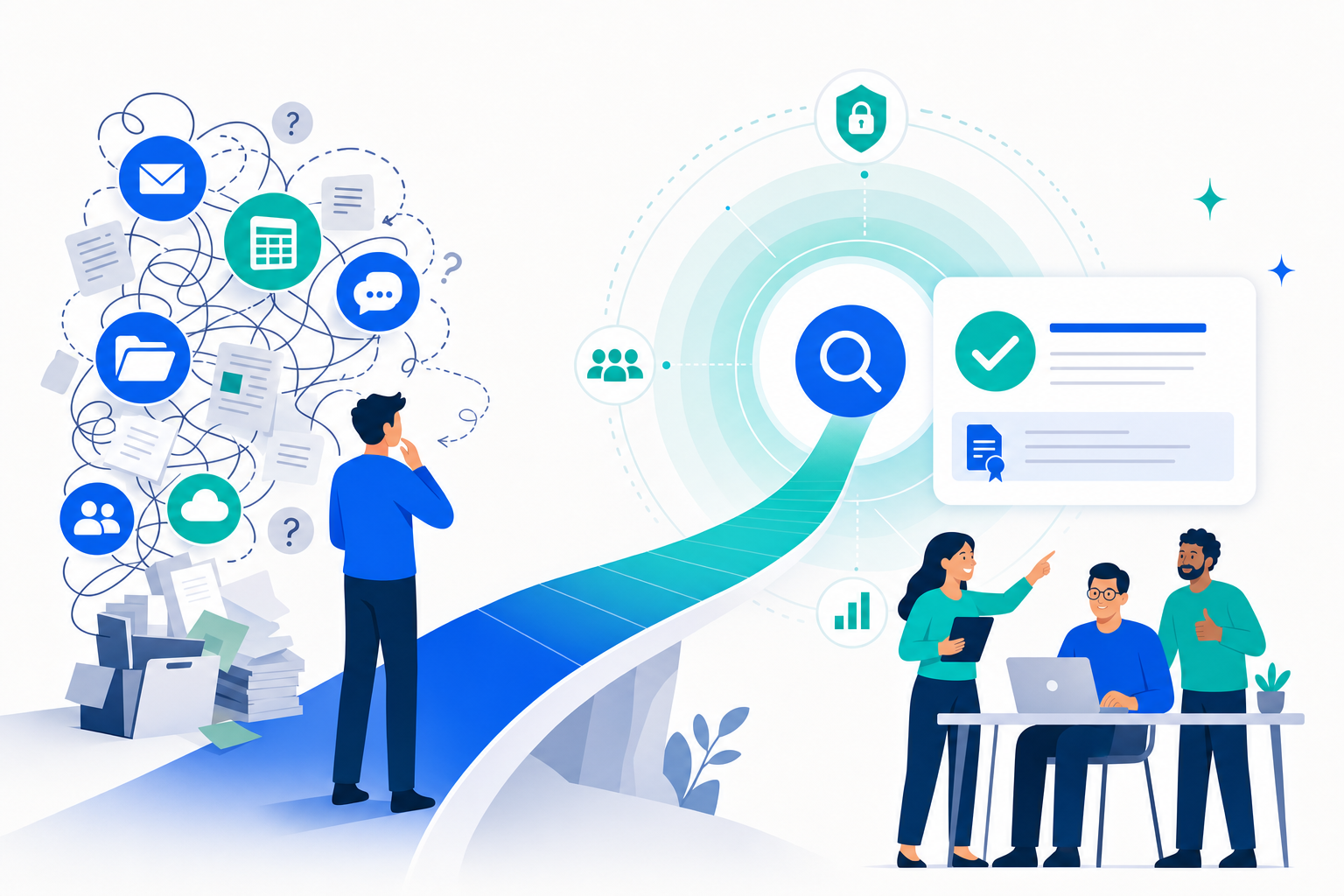
In many companies, the problem is no longer producing documentation. The problem is finding information that’s reliable enough to make a decision, take action, or postpone a decision—without having to go on another hunt for evidence across five different tools.
When content and decisions are scattered across various sources (files, emails, chats, wikis, project tools, business applications), your teams become “human middleware”: they manually copy, paste, cross-reference, and verify what the systems fail to connect. This situation creates a hidden cost, but above all, an operational risk: even when the information exists, no one can guarantee that it is accurate, up-to-date, and usable within the appropriate access rights framework.
This distinction makes all the difference: an effective internal search is not only fast—it is also verifiable, governed, and actionable.
Fragmentation is not an accident: it is the direct result of the accumulation of tools.
What this means for a project team, an operations team, or a Knowledge Manager: every new tool introduces its own search engine, conventions, versions, permissions, and sometimes its own “truth.” Without a cross-functional layer, internal search inevitably becomes incomplete and inconsistent.
When information doesn't flow smoothly between systems, individual productivity can increase… while slowing down the organization.
Operational interpretation: Internal research is no longer a “nice-to-have.” It’s about decision-making speed, quality of execution, and the reliability of reporting.
A “native” search engine is generally optimized for its specific scope. However, your knowledge is no longer limited to a single scope.
Simply storing files in the same location does not mean creating cross-functional, verifiable, and governed knowledge.
The research brief highlights five recurring patterns of failure: incomplete scope, overly lexical search, lack of a concept of documentary authority (approved version vs. draft), fragmented permissions, and a lack of analytics to address gaps (Summary of the Assessment, Multiple Sources, “Assessment and Field Evidence” section).
The useful debate isn’t “SharePoint is bad.” The useful debate is: What happens when SharePoint is just one of the places where decisions and evidence reside?
Microsoft explicitly acknowledges trade-offs and limitations in the “Restricted SharePoint Search” configuration:
What this means for teams: If you secure access by restricting it too much, you lose coverage; if you expand access without clarifying rights and versions, you increase the risk of exposure and confusion.
A Knowledge Manager is successful when the company stops asking, “Where’s the document?” and starts getting well-sourced, up-to-date answers that have an owner and a usage history.
The frustration described in the brief is clear: the inability to guarantee that the response links to up-to-date and authoritative content, because everything is scattered (the “Diagnosis by Persona” table, Section 2 of the brief).
Practical implication: Without search analytics (unanswered questions, contradictory content, outdated documents), governance is blind, and “knowledge” becomes a stockpile rather than a system.
A project status is reliable only if it can be traced back to the decisions, evidence, and versions that support it—not just to a single file.
In the brief, the Project Manager must piece together the context using reports, conversations, files, schedules, and decisions stored in various tools (see the “Diagnosis by Persona” table, Section 2).
What this changes: Internal searches used for project management must link documents, conversations, decisions, dates, and responsible parties; otherwise, trade-offs will resurface and dependencies will be lost.
When two dashboards show two different numbers, the real problem isn't the tool—it's the lack of a verifiable source and an audit trail.
The key pain point is “moving from steering to reconciliation” (brief, persona table). And the perspective immediately becomes strategic when we link this pain point to the impacts of decision-making: in the United Kingdom, three-quarters of employees surveyed report that decisions are delayed if information is missing or ambiguous (ITPro, May 15, 2026).
What this means for operations management: Reducing “copy-and-paste” isn’t just about saving time; it’s about producing reports that are more consistent, more defensible, and easier to explain.
Organizations are accelerating the adoption of AI, but AI without institutional memory produces unreliable responses.
Interpretation: AI is not a solution that simply “sits on top of” your silos; it becomes a force that amplifies… whatever you feed it. If knowledge is fragmented, outdated, or inaccessible, AI can be “fast but often off the mark” (Atlassian, “AI’s Speed Paradox,” April 10, 2026).
In 2026, Everest Group observes that traditional keyword-based approaches are becoming insufficient for providing accurate, contextualized, and secure access to information distributed across structured systems, documents, cloud platforms, and collaborative applications, and that the market is shifting toward hybrid/semantic search, sourced answers, and permission-based access (Everest Group, 2026).
In practical terms, a cross-functional layer that supports business units is based on five simple principles:
Internal research becomes a strategic asset when it transforms a question into a well-sourced and verified answer, rather than a list of links to check.
Two recent findings illustrate the difference between “searching” and “finding in order to act.”
If you need to set priorities, start with what builds trust:
The best improvement to internal search is often an improvement in governance (versions, permissions, owners) made visible through analytics.
The fragmentation of internal tools has become an issue affecting organizational performance and posing a risk:
The most robust solution is not to replace all your tools or add yet another system: it is to establish a cross-functional access layer that links sources, rights, versions, and evidence, so that internal research can finally support decision-making.
Outmind is positioned as a secure, high-precision AI research assistant that centralizes access to knowledge through internal tools (product briefs, positioning reports, and campaign data). Outmind highlights its ISO 27001-certified environment and “plug-and-play” approach (Outmind, article “alternative-glean…”).
What this means for teams: The goal is to ensure that every response can be linked to an internal source—while respecting access rights—in order to reduce version-related errors and minimize manual reporting (value propositions and differentiators, campaign data).